28
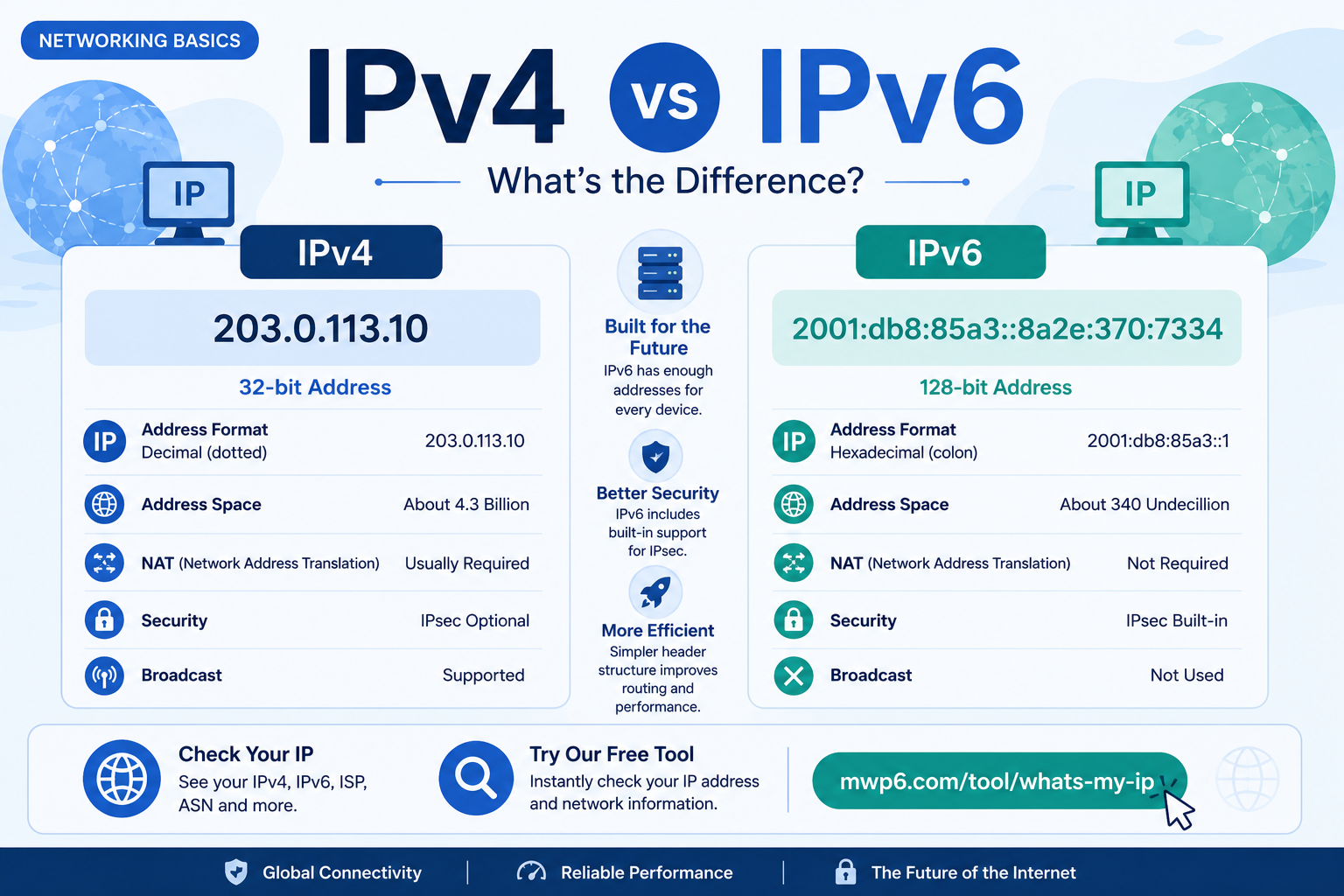
IPv4 vs IPv6: What's the Difference?
Compare IPv4 vs IPv6, learn the key differences, advantages, address formats, security, and how to check whether your internet connection supports IPv6.
Introduction
Every device connected to the internet uses an IP address to send and receive data. These addresses follow one of two standards: IPv4 or IPv6. While both serve the same purpose, they differ in structure, capacity, security, and how they support today's internet.
IPv4 has powered the internet for decades and is still the most widely used version. However, as more devices connect online every year, the limited number of IPv4 addresses has become a challenge. IPv6 was developed to solve this problem by providing a vastly larger address space along with several technical improvements.
If you've ever checked your public IP address and noticed both an IPv4 and an IPv6 address, you may have wondered why both exist and whether one is better than the other.
In this guide, we'll compare IPv4 and IPv6, explain their differences, and help you understand which version your internet connection uses.
What Is IPv4?
IPv4 (Internet Protocol version 4) is the fourth version of the Internet Protocol and has been the foundation of internet communication since the early 1980s.
An IPv4 address consists of four numbers separated by periods.
Example:
203.0.113.10
Each section ranges from 0 to 255, creating approximately 4.3 billion unique addresses.
At the time IPv4 was introduced, this seemed more than enough. Today, billions of smartphones, computers, smart TVs, IoT devices, and cloud servers have exhausted most available IPv4 addresses.
What Is IPv6?
IPv6 (Internet Protocol version 6) was created to replace IPv4 and support the continued growth of the internet.
Instead of four decimal numbers, IPv6 uses eight groups of hexadecimal characters separated by colons.
Example:
2001:db8:85a3::8a2e:370:7334
IPv6 provides approximately 340 undecillion unique addresses—a number so large that address exhaustion is no longer a practical concern.
This allows every internet-connected device to have its own globally unique IP address.
IPv4 vs IPv6: Side-by-Side Comparison
FeatureIPv4IPv6Address length | 32-bit | 128-bit
Address format | Decimal | Hexadecimal
Example | 203.0.113.10 | 2001:db8::1
Number of addresses | About 4.3 billion | About 340 undecillion
NAT required | Usually | Rarely
Header complexity | More complex | Simpler and more efficient
Built-in IPsec support | Optional | Native support
Broadcast | Supported | Not used
Future scalability | Limited | Extremely high
Why Was IPv6 Created?
The biggest reason for developing IPv6 was the shortage of IPv4 addresses.
As the internet expanded, the number of connected devices grew rapidly. Smartphones, gaming consoles, smart home devices, cloud services, and connected vehicles all require IP addresses.
Rather than continually relying on workarounds like Network Address Translation (NAT), IPv6 provides enough addresses to support future internet growth for many decades.
Address Format Differences
One of the easiest ways to distinguish IPv4 from IPv6 is by looking at the address itself.
IPv4 Example
198.51.100.25
IPv6 Example
2001:0db8:85a3:0000:0000:8a2e:0370:7334
IPv6 addresses are longer because they contain far more possible combinations.
To improve readability, IPv6 allows sections of zeros to be abbreviated using shorthand notation.
Is IPv6 Faster Than IPv4?
Not necessarily.
IPv6 itself does not automatically increase internet speed.
However, some users may experience slightly better performance because:
- Network routing can be more efficient.
- IPv6 avoids some NAT-related processing.
- Certain websites optimize IPv6 connections.
In most cases, the speed difference between IPv4 and IPv6 is minimal and depends more on your ISP and network infrastructure than the protocol itself.
Is IPv6 More Secure?
IPv6 was designed with modern networking in mind and includes native support for IPsec, a suite of protocols used to secure internet communications.
However, using IPv6 does not automatically make your internet connection secure.
Security still depends on factors such as:
- Firewalls
- Software updates
- Strong passwords
- Secure network configuration
- VPNs when appropriate
Whether you use IPv4 or IPv6, following good security practices remains essential.
Can IPv4 and IPv6 Work Together?
Yes.
Most modern networks support both protocols using a configuration called Dual Stack.
With Dual Stack:
- Devices can communicate using IPv4.
- Devices can also communicate using IPv6.
- The system automatically chooses the appropriate protocol depending on what the destination supports.
This allows a gradual transition from IPv4 to IPv6 without disrupting internet access.
Why Are Many Websites Still Using IPv4?
Although IPv6 adoption continues to grow, IPv4 remains widely used because:
- Older hardware may not support IPv6.
- Some enterprise systems still rely on IPv4.
- Many internet providers continue to operate IPv4 infrastructure.
- Transitioning large networks takes time.
As a result, both protocols currently coexist across much of the internet.
How to Check Whether You're Using IPv4 or IPv6
The easiest way to find out which protocol your connection is using is to check your public IP address.
Our free What Is My IP tool instantly displays your:
- Public IPv4 address
- Public IPv6 address (if available)
- ISP
- Organization
- ASN
- Approximate IP location
Simply visit:
https://mwp6.com/tool/whats-my-ip
If your network supports IPv6, the tool will display it alongside your IPv4 address.
Should You Switch to IPv6?
For most users, there's nothing you need to configure manually.
If your ISP supports IPv6, your router and devices will usually enable it automatically.
You should consider enabling IPv6 if:
- Your ISP provides IPv6 connectivity.
- Your router supports IPv6.
- Your devices support modern networking standards.
Most modern operating systems, smartphones, and routers already support IPv6 by default.
Frequently Asked Questions
Which is better, IPv4 or IPv6?
IPv6 is the newer protocol and offers significant advantages in scalability and address availability. However, IPv4 remains essential because many networks still rely on it.
Can IPv6 completely replace IPv4?
Eventually, yes. However, the transition is gradual, and both protocols will continue to coexist for years.
Why do I have both an IPv4 and an IPv6 address?
Many internet providers use Dual Stack networking, allowing your devices to communicate using either protocol depending on the destination.
Does IPv6 improve gaming?
In most cases, gaming performance depends on latency and network quality rather than whether you're using IPv4 or IPv6.
Can I disable IPv6?
Yes, but it is generally not recommended unless you're troubleshooting a specific networking issue.
How do I know if my ISP supports IPv6?
The easiest way is to check your public IP address. If your connection has an IPv6 address, your ISP supports IPv6.
How can I see my IPv4 and IPv6 addresses?
You can instantly view both using our free What Is My IP tool.
Conclusion
IPv4 and IPv6 serve the same purpose, but they were designed for different stages of the internet's evolution. IPv4 laid the foundation for the modern internet, while IPv6 ensures there are enough addresses to support billions of new devices in the future.
Today, most users benefit from both protocols working together behind the scenes. Understanding the differences can help you troubleshoot network issues, configure devices, and better understand your internet connection.
To see whether your connection is using IPv4, IPv6, or both, visit our free What Is My IP tool:
https://mwp6.com/tool/whats-my-ip
It instantly displays your public IP addresses along with your ISP, ASN, organization, and other useful network information.
Contact
Missing something?
Feel free to request missing tools or give some feedback using our contact form.
Contact Us