28
What Is ASN? Understanding Autonomous System Numbers
Learn what an ASN (Autonomous System Number) is, how it works, why networks use it, and how to find the ASN associated with your public IP address.
Introduction
Every time you connect to a website, stream a video, or send an email, your internet traffic passes through multiple networks before reaching its destination. Behind this global communication system is a technology called the Autonomous System Number (ASN).
Although most internet users never notice ASNs, they play a critical role in how data travels across the internet. Internet service providers, cloud platforms, and large organizations all use ASNs to exchange routing information and ensure traffic reaches the correct destination efficiently.
If you've used an IP lookup tool, you may have seen information like AS15169, AS13335, or AS16509 next to your IP address and wondered what those numbers mean.
In this guide, you'll learn what an ASN is, why it exists, how it works, and why your IP address is associated with one.
What Is an Autonomous System?
An Autonomous System (AS) is a collection of IP networks managed by a single organization that follows a common routing policy.
Instead of every router on the internet communicating with every other router individually, networks are grouped into autonomous systems. Each system manages its own routing internally while communicating with other autonomous systems using standardized protocols.
Examples of organizations that operate autonomous systems include:
- Internet Service Providers (ISPs)
- Cloud hosting companies
- Large enterprises
- Universities
- Government agencies
- Content delivery networks (CDNs)
For example, your internet provider may operate one autonomous system, while Google, Cloudflare, Amazon, and Microsoft each operate their own.
What Is an ASN?
An Autonomous System Number (ASN) is a unique identifier assigned to an autonomous system.
Think of it as an identification number for an entire network rather than for an individual device.
Just as every website has a domain name and every device has an IP address, every autonomous system has an ASN.
Examples include:
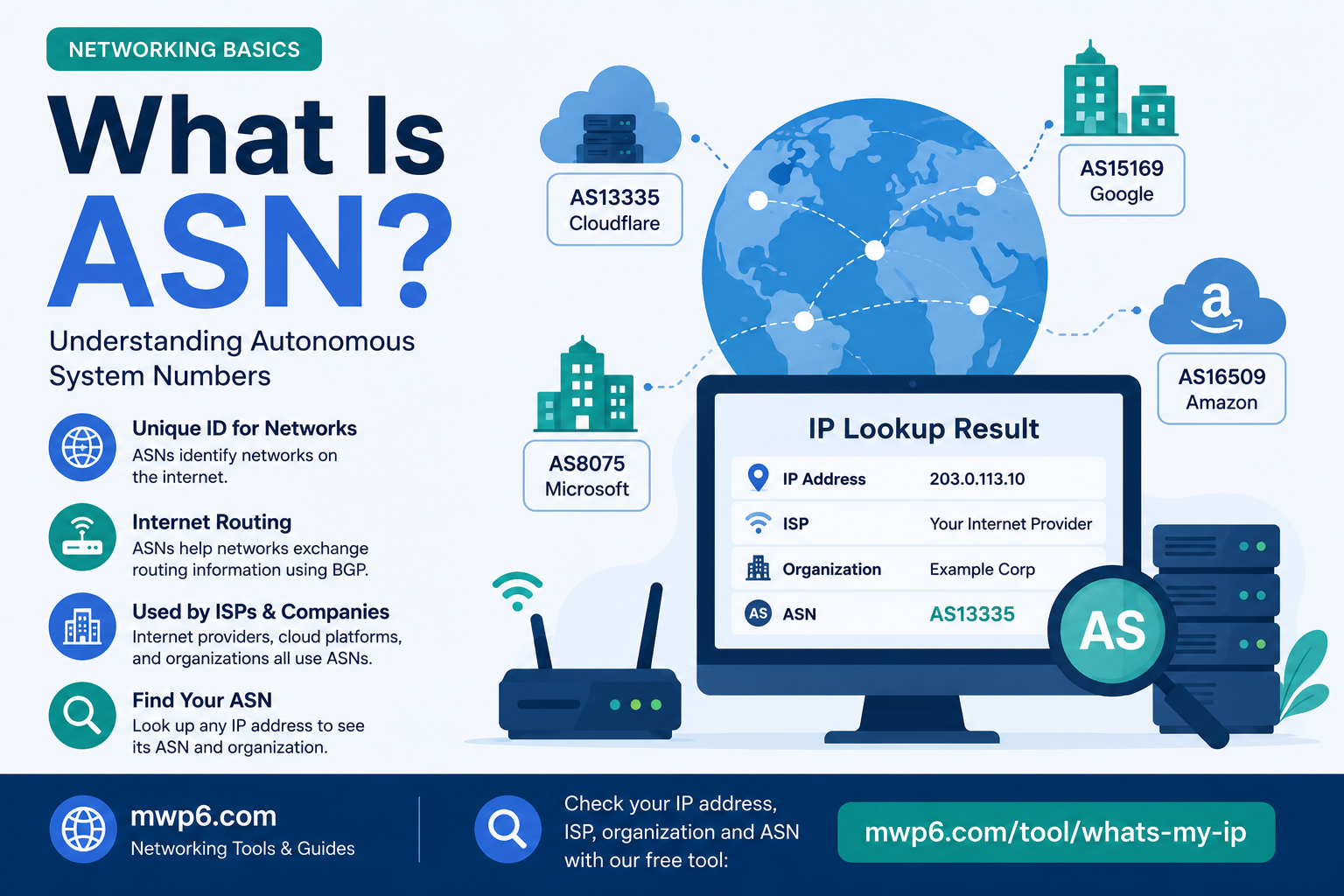
- AS15169 — Google
- AS13335 — Cloudflare
- AS16509 — Amazon
- AS8075 — Microsoft
These numbers allow routers across the internet to identify which network they are communicating with.
Why Do Networks Need ASNs?
The internet is made up of thousands of independently managed networks.
Without ASNs, routers would have no standardized way to determine where traffic should be sent.
ASNs help networks:
- Exchange routing information
- Select the best path for internet traffic
- Avoid routing loops
- Improve reliability
- Support multiple internet providers
- Scale the global internet efficiently
Every time you open a website, routing decisions based on ASNs help deliver data quickly and reliably.
How Does an ASN Work?
Autonomous systems communicate using the Border Gateway Protocol (BGP), the routing protocol that connects the world's largest networks.
Here's a simplified example:
- You visit a website.
- Your ISP receives the request.
- BGP determines which autonomous systems should carry the traffic.
- Your request passes through one or more ASNs.
- The destination network responds using the best available route.
Rather than relying on a single global router, BGP allows autonomous systems to exchange routing information continuously and adapt to network changes.
Who Assigns ASNs?
ASNs are allocated by the Internet Assigned Numbers Authority (IANA) through Regional Internet Registries (RIRs).
The five Regional Internet Registries are:
RegistryRegionAFRINIC | Africa
APNIC | Asia-Pacific
ARIN | North America
LACNIC | Latin America and Caribbean
RIPE NCC | Europe, Middle East, and Central Asia
Internet providers and organizations request an ASN from the appropriate regional registry when they need to manage independent routing.
Public ASN vs Private ASN
Not every ASN is visible on the public internet.
Public ASN
A public ASN is globally unique and used to exchange routing information with other autonomous systems across the internet.
Examples include:
- ISPs
- Cloud providers
- Large enterprises
Private ASN
Private ASNs are intended for internal use within an organization and are not advertised on the public internet.
They are commonly used for:
- Enterprise networks
- Internal routing
- Testing environments
- Private WANs
16-bit vs 32-bit ASN
Originally, ASNs were limited to 16 bits, allowing approximately 65,000 unique numbers.
As the internet grew, this range became insufficient.
Today, 32-bit ASNs are widely supported, expanding the available pool to billions of unique identifiers and ensuring enough ASNs for future growth.
Most modern networking equipment supports both formats.
Real Examples of ASNs
Many of the internet's largest organizations operate their own autonomous systems.
OrganizationExample ASNGoogle | AS15169
Cloudflare | AS13335
Amazon | AS16509
Microsoft | AS8075
Meta (Facebook) | AS32934
When you access services from these companies, your internet traffic often passes through their autonomous systems.
How to Find the ASN for an IP Address
The easiest way to identify the ASN associated with an IP address is by using an IP lookup tool.
Our free What Is My IP tool instantly displays useful network information, including your:
Public IPv4 or IPv6 address
Internet Service Provider (ISP)
Organization
Autonomous System Number (ASN)
Approximate IP location
If you're curious which autonomous system your internet connection belongs to, simply check your current IP using our tool:
https://mwp6.com/tool/whats-my-ip
Whether you're troubleshooting a network issue, verifying a VPN connection, or learning more about how the internet works, checking your ASN is a great place to start.
Why Does Your IP Address Have an ASN?
Every public IP address belongs to an organization that owns or manages a block of IP addresses.
That organization is usually assigned an ASN.
For example, if your ISP owns your public IP address, your IP will typically be associated with your ISP's ASN. If you're using a VPN, cloud server, or hosting provider, your IP will instead be associated with that organization's ASN.
This is why your ASN may change when you switch internet providers or connect through a VPN.
Why Should You Care About ASNs?
Most people never need to configure or manage an ASN directly, but understanding them can still be useful.
Knowing your ASN can help you:
- Understand who owns your public IP address
- Verify whether your VPN is using the expected network
- Troubleshoot internet routing issues
- Learn how internet traffic reaches websites
- Interpret the results shown by IP lookup tools
If you're interested in networking, cybersecurity, or cloud computing, understanding ASNs provides valuable insight into how the internet operates behind the scenes.
Frequently Asked Questions
What does ASN stand for?
ASN stands for Autonomous System Number, a unique identifier assigned to a network that participates in internet routing.
Is an ASN the same as an IP address?
No. An IP address identifies a device or network interface, while an ASN identifies an entire network operated by an organization.
Can one ASN have multiple IP addresses?
Yes. Most autonomous systems manage thousands or even millions of IPv4 and IPv6 addresses.
Do home users have their own ASN?
Usually not. Home internet users typically use the ASN of their internet service provider.
Can an organization have more than one ASN?
Yes. Large companies may operate multiple autonomous systems for different regions or services.
Does every ISP have an ASN?
Most internet service providers have at least one public ASN to exchange routing information with other networks.
How can I find the ASN for my IP address?
The quickest way is to use an IP lookup tool that displays your public IP address along with your ISP, organization, and ASN.
Conclusion
Autonomous System Numbers are one of the building blocks of the modern internet. While they're mostly invisible to everyday users, they help networks exchange routing information and keep internet traffic flowing efficiently between organizations around the world.
The next time you check your public IP address, don't overlook the ASN shown in the results. It tells you which network your connection belongs to and offers valuable insight into how your internet traffic reaches its destination.
You can instantly view your public IPv4 or IPv6 address, ISP, organization, and ASN with our free What Is My IP tool:
https://mwp6.com/tool/whats-my-ip
It's a quick way to better understand your internet connection and the network behind it.
Contact
Missing something?
Feel free to request missing tools or give some feedback using our contact form.
Contact Us