27
What Is IPv6? Everything You Need to Know
Learn what IPv6 is, why it was created, how it works, and how it compares with IPv4. Discover the benefits of IPv6 and how to check whether your internet connection supports it.
Introduction
IPv6 (Internet Protocol version 6) is the latest version of the Internet Protocol designed to replace IPv4. As billions of new devices connect to the internet every year, the limited number of IPv4 addresses is no longer enough. IPv6 solves this problem by providing an enormous number of unique IP addresses while also improving routing efficiency, scalability, and network performance.
Today, many Internet Service Providers (ISPs), websites, and operating systems support both IPv4 and IPv6, allowing devices to communicate using either protocol.
If you'd like to check whether your internet connection is using IPv4, IPv6, or both, use our free What Is My IP Address tool:
https://mwp6.com/tool/whats-my-ip
What Is IPv6?
IPv6 stands for Internet Protocol version 6.
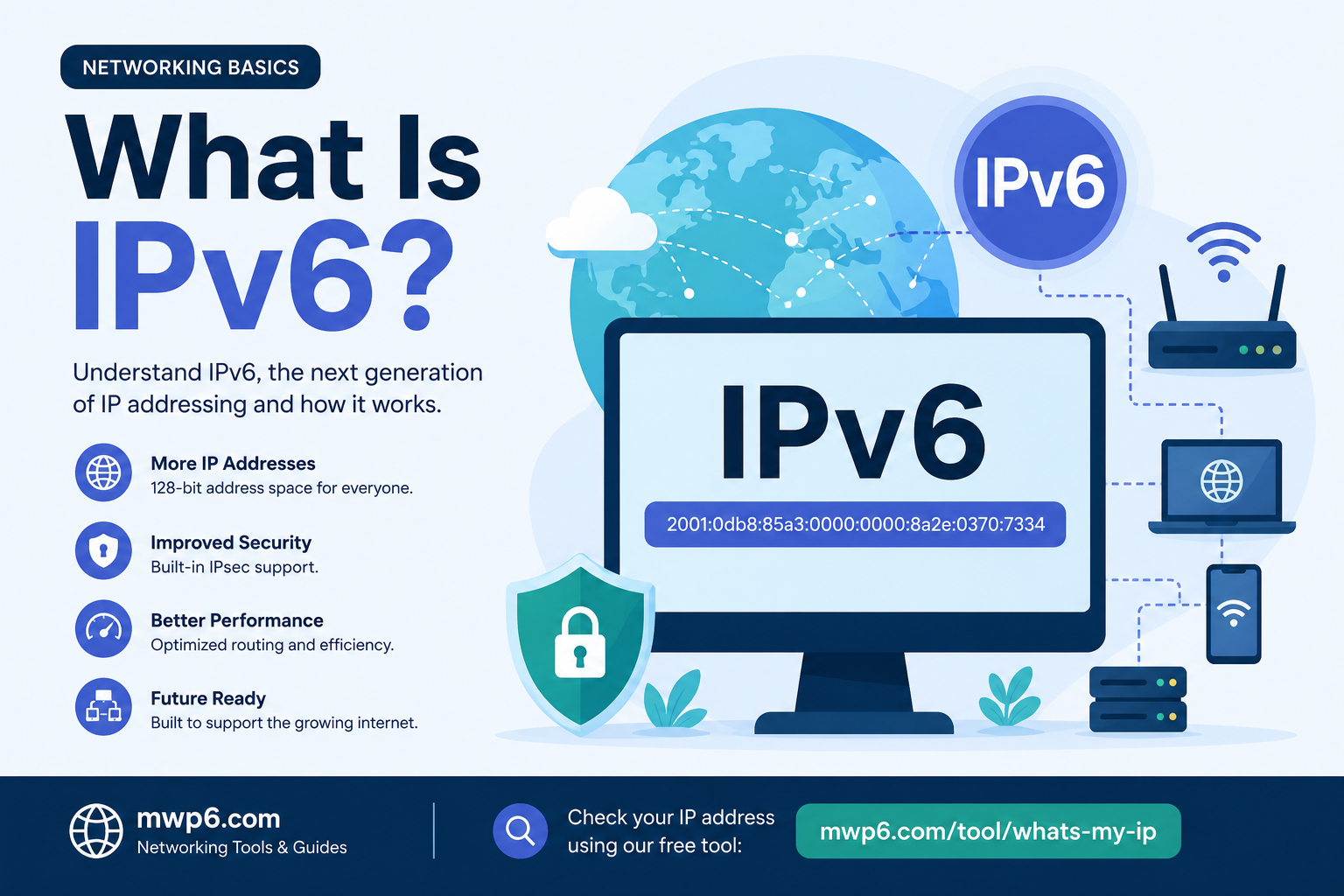
Like IPv4, it assigns a unique address to every device connected to the internet. The main difference is that IPv6 uses 128-bit addresses, allowing an almost unlimited number of unique IP addresses.
An example of an IPv6 address looks like this:
2001:0db8:85a3:0000:0000:8a2e:0370:7334
Unlike IPv4, which uses four groups of numbers separated by periods, IPv6 uses eight groups of hexadecimal values separated by colons.
Why Was IPv6 Created?
IPv4 supports approximately 4.3 billion unique addresses.
When IPv4 was introduced in the early days of the internet, this seemed more than enough. However, with billions of smartphones, computers, tablets, smart TVs, IoT devices, and cloud servers now connected worldwide, the available IPv4 addresses have largely been exhausted.
IPv6 was created to solve this limitation and support the continued growth of the internet.
How Does IPv6 Work?
IPv6 works similarly to IPv4 by uniquely identifying devices on a network.
When you visit a website:
- Your device sends a request using its IPv6 address.
- The website receives the request.
- The server sends the requested information back to your IPv6 address.
- Your browser displays the webpage.
From the user's perspective, everything works just like IPv4, but with a much larger addressing system behind the scenes.
IPv4 vs IPv6
IPv4IPv632-bit addresses | 128-bit addresses
Around 4.3 billion addresses | Virtually unlimited addresses
Uses decimal numbers | Uses hexadecimal numbers
Example: 203.0.113.45 | Example: 2001:db8::1
Requires NAT in many networks | Designed to reduce the need for NAT
What Are the Benefits of IPv6?
IPv6 offers several advantages over IPv4:
- Vastly larger address space
- Better support for modern internet growth
- More efficient routing
- Improved network scalability
- Better support for mobile devices
- Simplified network configuration
- Reduced dependence on Network Address Translation (NAT)
These improvements make IPv6 better suited for the future of the internet.
Do I Have an IPv6 Address?
Many users already have IPv6 without realizing it.
If your Internet Service Provider supports IPv6 and your router is properly configured, your device may automatically receive both an IPv4 and an IPv6 address.
The easiest way to check is with our free What Is My IP Address tool.
It instantly displays:
- Public IPv4 address
- Public IPv6 address (if available)
- ISP
- ASN
- Approximate location
- Timezone
- Geographic coordinates
- Additional network information
Check your connection here:
https://mwp6.com/tool/whats-my-ip
Why Do We Still Use IPv4?
Although IPv6 is newer, IPv4 remains widely used because much of today's internet infrastructure still depends on it.
Most networks now operate using Dual Stack, meaning they support both IPv4 and IPv6 simultaneously.
This allows older systems and newer technologies to work together without compatibility issues.
Frequently Asked Questions
Is IPv6 faster than IPv4?
Not necessarily.
Internet speed depends mainly on your ISP and network quality. However, some networks may experience slightly better routing performance with IPv6.
Can I disable IPv6?
Yes.
Most operating systems allow IPv6 to be disabled, although doing so is generally not recommended unless required for troubleshooting.
Can I use both IPv4 and IPv6?
Yes.
Most modern devices support both protocols at the same time.
Is IPv6 more secure?
IPv6 was designed with modern networking in mind and includes support for technologies such as IPsec. However, overall security still depends on proper network configuration and security practices.
How do I know if my ISP supports IPv6?
The easiest way is to check your connection using our What Is My IP Address tool. If an IPv6 address is displayed, your connection supports IPv6.
https://mwp6.com/tool/whats-my-ip
Conclusion
IPv6 is the future of internet addressing. By providing an enormous number of unique addresses and improving network scalability, it ensures that the internet can continue growing for decades to come.
Although IPv4 is still widely used, more networks are adopting IPv6 every year. Understanding how IPv6 works can help you better understand modern networking and prepare for the future.
If you'd like to see whether your connection supports IPv6, along with your public IP address, ISP, ASN, location, and other network details, try our free tool:
👉 https://mwp6.com/tool/whats-my-ip
Contact
Missing something?
Feel free to request missing tools or give some feedback using our contact form.
Contact Us